























Frequently Asked Questions
Engineered Timber Flooring FAQs
“Engineered” refers to the construction of the timber flooring plank. An engineered timber plank consists of more than one layer, as opposed to solid timber which is one single layer or one single “solid” plank of wood.
Engineered timber is “engineered” to be more stable than traditional solid timber planks. More stable means that it is less susceptible to cupping, bowing and warping, therefore less prone to problems after install.
With engineered timber, each layer of an engineered board is placed so that the grain runs perpendicularly, giving it much more strength and stability and making any expansion or contraction with changes in atmospheric conditions very minimal. Engineered timber is highly suitable to Australian building projects due to our volatile climate.

Yes. The top layer of an engineered timber board (the lamella or wear layer) is genuine solid wood, usually hardwood, and may be anything from 0.6 to 6mm thick. This means that yes, engineered timber flooring is genuine real timber and will look no different to traditional solid timber flooring.
The lamella is securely bonded to one or more following layers. These following layers can vary in their materials from product to product. They may consist of a multi-layered plywood, or a solid core of either softwood or hardwood. The final layer is a stabilising backing board of either birch, ply or similar material.
Engineered timber flooring is one of the most common types of wood flooring used around the world. This is due to its many benefits including:
Highly stable - Engineered timber flooring is highly suited to the Australian volatile climate conditions. Engineered is much more stable than traditional solid timber flooring due to its construction, making it less susceptible to cupping, bowing and warping.
Cost effective - Engineered flooring presents a competitive option compared to solid timber, offering a cost-effective solution, especially when compared to unfinished solid timber that requires sanding and finishing after install. Advancements in technology and increased demand have streamlined production, making engineered flooring a practical and efficient choice. Additionally, installation costs are reduced as engineered flooring typically requires less time and effort to install than solid timber flooring.
Faster, easier installation - Engineered timber flooring is available in pre-finished planks, meaning reduced installation time and cost as you do not need to finish it on-site. Engineered timber flooring is available in either tongue and groove profiles or a simple install click-system which allows for very fast, easy install.
Larger range, more choice - Engineered timber flooring is available in a much larger and comprehensive range of colours, sizes and finishes than solid timber flooring.
Underfloor heating compatibility - The majority of engineered timber flooring products are able to be fitted over underfloor heating (conditions do apply, please contact us for more info).
Sustainable choice - Engineered timber construction enables many more planks to be constructed from a single tree, meaning less wastage and better use of slow-growing timbers.
Production and transport of timber has a lower impact on carbon emissions compared to the many other building materials due to timber being lighter in weight.
Timber also holds CO2 for the duration of its life. By continuing the life of the timber in flooring or other such materials, the CO2 is kept from releasing into the atmosphere. Less CO2 in our atmosphere is good for the planet!
The terms “laminate” and “veneer” refer to the process of construction of securing a thin layer of one material to another, rather than an actual product.
In some cases, such as our Par-ky collection or our PurePanel Veneers, these boards are technically considered a veneer as this refers to the use of a very thin layer of material secured to another layer of material.
However, often these two terms are confused with meaning that a product is “imitation”, vinyl or “fake” rather than genuine timber and this is not the case.
Engineered timber flooring, no matter how thin the “veneer” wear layer is, is genuine, real hardwood flooring, and in the case of our PurePanel Veneers, real wood for cabinetry and joinery work.
You can rest assured that you are purchasing genuine, real timber products from Havwoods, even when the wear layer is 0.6mm!
Our European Oak is sourced from the highest quality and reputable suppliers all over Europe. Many of our products are also manufactured in Europe, others are made in Asia under strict quality and ethics control. We do not compromise on quality and strive to provide a broad range of product options and prices to ensure we can find the perfect solution for your budget and project needs.
Oil penetrates deep into the timber and brings out the true beauty of both the colour and grain as well as providing protection for the floor. In addition to providing a natural look, oiled floors lend themselves to being very easy to spot repaired in the event of slight surface damage.
Some oiled floors require an additional coat of oil or Hardwax Oil, a mixture of sunflower, soybean and thistle oil, carnauba and candelilla wax after installation - check with your Havwoods consultant for more information.
Lacquer is normally a polyurethane coating which is applied to the surface of a wooden floor by brush or roller. The polyurethane covers the pores of the wood and forms a hard, resilient coating which protects the timber from dirt and moisture ingress.
Lacquer is commonly either a matt, satin or gloss finish. While it does offer more protection than an oil coating, if damaged, lacquered boards need to be replaced rather than repaired as a laquered product is unable to be spot repaired.
No. The thickest of European Oak top layer such as a 6mm lamella, is no harder than 2mm of European Oak. In fact, the thicker the top layer, the deeper any dents may be.
The benefits of having a thicker wear layer is in being able to sand your floor if this is something you would like to be able to do in the future. The thicker the wear layer, the more times you will be able to sand the floor.
However, very few engineered timber floors require resanding due to modern durability. Resanding, depending on the design of the board, may also remove finishes, texture and colouring which means it may need to be refinished again.
Thicker wear layer products are more expensive than thinner wear layers due to the fact that they are using more hardwood.
There are both thick and thin wear layers available, speak with your Havwoods consultant for help on deciding which thickness will best suit your project’s needs.
As with all real timber products over the years it will experience natural wear including scratches and marks. Whilst this does add character, it is important to understand that certain items such as grit, sharp objects, high heels, pet claws, sticky tape and unprotected furniture can all impact the surface of timber.
Speak with your Havwoods consultant to learn how to best maintain your timber flooring for a long life.
Engineered timber construction enables many more planks to be constructed from a single tree, meaning less wastage and better use of slow-growing timbers.
Choosing timber is also one of the most eco friendly building materials you can select, provided you choose your timber from reputable and ethical suppliers.
Responsibly sourced timber ensures that the trees are replaced, wildlife is protected, and local villages are employed under fair-work conditions.
Production and transport of timber has a lower impact on carbon emissions compared to the majority of other building materials due to timber being lighter in weight.
Timber also holds CO2 for the duration of its life. By continuing the life of the timber in flooring or other such materials, the CO2 is kept from releasing into the atmosphere. Less CO2 in our atmosphere is good for the planet! Choosing ethically sourced timber is choosing a brighter future for our planet.
Timber Grading & Characteristics
Timber grades refers to the level of variation and characteristics allowed to be present per grade. For example, a “Rustic” grade product will contain every possible natural characteristic such as knots, medullary rays, colour variation and more. In contrast, a “Prime” grade product will contain much less of these characteristics. The look you are going for in your design will help to determine which grade of timber flooring will suit your desired outcome.
There is no universal grading system in place and as a result, each timber flooring supplier will have slightly different terminology and criteria for grading their products. Havwoods grades are as follows:
Rustic
Also known as “Natural”, rustic grade allows a limitless size and number of knots and other natural timber characteristics. There will be colour variation, sapwood, checks, shake and medullary rays. Filler will be used and the colour of filler is selected to complement the floor rather than to match it exactly. Filler colour may vary from batch to batch.
Character
Character grade is very similar to rustic, however any natural knots or other characteristics will be slightly smaller and less present.
Classic
Typically Classic grade will have a mix of cleaner boards with other planks which have more knots. Larger knots are allowed in this grade. Heartwood and colour variation in the timber should be expected and there will be some checks (cracks across the growth ring), sapwood and filler. The colour of the filler is carefully selected to complement the wood rather than to match it exactly and it may vary from batch to batch.
Prime
Prime grade timber contains few, if any, knots and these will be minimal in size. There will be a minimal amount of sapwood and filler, if any at all - it will vary from batch to batch. Where filler is used, its colour is carefully selected to complement the wood rather than to match it exactly. Filler colour may vary from batch to batch. There will be a relatively small amount of colour variation to be expected.
Timber is a product of nature and as such, variation is to be expected. Every tree is unique and as such, every single timber flooring plank is unique.
The natural characteristics, uniqueness and beauty of timber is one of the reasons it is so highly sought after as a material choice.
Your installer will open several boxes at time of installation and “dry-lay” the floor to ensure the colours are mixed throughout the flooring layout. Mixing up the boards from different packs ensures an even spread of different tones and characters over your entire floor layout.
Here are some of the variations you can expect from a genuine timber floor:
Knots
A natural characteristic of a tree, a knot is a feature created by a branch, around which the grain has flown. Different grades determine how many knots will be present in your flooring product.
Whether you prefer knots in your flooring or not will be determined by the look you are after - a more “rustic” style would lend itself to a flooring with more character and knots, where as modern, contemporary interiors tend to lean towards less knots with a more sleek and uniform look.

Filler
Filler is used to “fill” any large knots that create small holes in the timber. Filler may be white, grey, brown or black and varies from product to product. Similar to knots, the grade of your timber will determine how much filler may be present in your flooring.

SapwoodSapwood is the part of the tree through which water and sap flow. It is always lighter in colour than the rest of the plank and certain finishing processes can make sapwood even more pronounced. Sapwood is not a defect but rather a natural part of the tree and therefore a natural and expected characteristic of a genuine timber floor.
Certain products do contain a higher likelihood of sapwood than others. Please speak with your Havwoods consultant if you are looking to reduce (or increase!) sapwood in your design as due to its lighter appearance, it can often come as a surprise characteristic if unaware of its possibility.

Medullary rays, checks and shakesMedullary rays are white ribbon-like features in timber that has been quarter-sawn during production. Checks and shakes are a natural characteristic found in timber. These markings provide unique character in a floor however they are not always visible until after install.

These characteristics are not defects and do not compromise the quality or durability of the flooring but rather display the unique beauty of nature present in a genuine timber product. Shakes, while not considered a defect, are covered under warranty by Havwoods.
Installation
Yes, the majority of Havwoods engineered boards are able to be installed over underfloor heating - however conditions do apply and vary from product to product.
Check with your Havwoods consultant prior to purchase to ensure your selected product is suitable.
A floating floor installation is one where the planks are attached to each other instead of to the subfloor over which it is being laid. The floor can be removed easily too, making it more cost effective for short term requirements where the flooring is more likely to be changed within the foreseeable future.
Read our article about floating and glue down timber flooring installation methods here.
At Havwoods, we make your flooring installation journey simple and stress-free. While we don’t install timber flooring ourselves, we’ve spent decades building a trusted national network of skilled flooring installers - so you don’t have to.
To learn more about our installation service, click here.
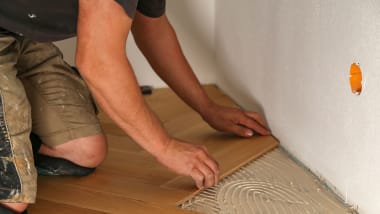
Glue-down or direct stick installation is a method of install that bonds the timber flooring to the substrate using wood flooring adhesive glue. Glue-down is often the preferred method of install as it adds extra stability to the floor and reduces noise transmission.
Read more about glue down and floating installation methods here.
Laying a new timber floor over existing tiles and floorboards is possible, however it does require careful consideration regarding the condition of the existing floor, ensuring there is no cracks, loose tiles or boards and no dampness.
Assessing the new floor height will be essential to ensure no issues will be created with regards to door clearances and transitions. The most important item is to ensure the floor is prepped and level before laying new flooring. It is best to advise your floor installer to obtain a technical document from Havwoods to ensure your existing floor is suitable.
It is recommended that skirting boards go in after your timber flooring, this allows for a clean finish and covers any expansion gap between the wall and the flooring. However if you have existing skirting boards that are not able to be removed, speak to Havwoods for other finishing options.
To minimise noise when installing hard flooring in an apartment complex or second storey home, it's best to install an acoustic underlay beneath your timber flooring. This layer of underlay beneath your timber flooring boards helps reduce both impact and airborne noises, ensuring a quieter and more pleasant environment. Havwoods can provide information on noise transmission when required for strata and include underlay in your quote.
Care and Maintenance
Oiled wood floors are very easy to care for. For everyday cleaning to remove dust or loose debris a broom, vacuum cleaner with a wood floor setting or dry mop is all that is required.
For more thorough cleaning, damp mop using a diluted oiled wood floor cleaner. In public places where the footfall is greater, oiled wood floors may be damp mopped on a daily basis and should be treated regularly with a maintenance wax. This may be applied to the most heavily used areas or to the whole floor, spreading it with an electric, single-disc buffing machine with a beige pad.
Maintenance wax need only be applied to residential flooring when the wood begins to look a little lifeless.
Timber floors contribute to a healthy living environment for all of the family, including pets. Unlike carpets, timber floors don't trap dust, dirt, or pet dander so help to improve indoor air quality and reducing allergens.
It is important to keep pet claws trimmed to reduce any abrasion that these can cause. Maintenance products can be applied to reduce the appearance of minor scratches over time.
This depends largely on the product you have selected. Products with a thicker wear layer may be sanded and refinished, however very few engineered timber floors are ever resanded due to modern durability. Resanding will also likely remove any finish, texturing and colouring your flooring had which means you will need to refinish the flooring on site and it may be difficult to return it to the original look after sanding.
Contact us if you have questions about sanding and refinishing an existing floor and we will be happy to help discover your options with you.
Dents and scratches may occur over time these can be fixed with the application of maintenance products or easy to use repair kits. Havwoods offers an Accessories range for maintenance and repair products.
There are also preventative measures you can take such as rugs or felt pads under furniture and mats at entranceways.
We recommend keeping some additional left over planks in the event your flooring receives damage that is not able to be spot repaired. The damaged planks may be able to be replaced by the left over boards.
UV light can change the colour of your timber floor, just as it does with other materials like carpet. Timber is photosensitive, meaning exposure to UV light can alter its colour, sometimes creating a yellow hue or darkening the tone. The extent of this change depends on the amount of UV exposure your floor receives.
To slow the process, consider installing blinds, curtains, or other coverings. Please note, these colour changes are a natural characteristic of timber and are not considered a product defect.
Certification
FSC® stands for Forestry Stewardship Council. It is an independent, non-government, not-for-profit organisation established to promote the responsible management of the world’s forests.
The FSC® principles and criteria aim to ensure that forests can be managed to meet the social, economic, ecological and cultural needs of both present and future generations. Products may be from an FSC® source but cannot carry the FSC® label unless the chain of custody throughout is FSC® approved.
Havwoods' FSC® certified (C009500) product ranges are as follows:

Cradle to Cradle Certified™ is a globally recognised measure of safer, more sustainable products made for the circular economy.
Cradle to Cradle Certified provide global product design standards that guide brands and manufacturers in how to make products that have a transformative and positive impact on people and planet. Cradle to Cradle Certified™ enabling consumers to follow responsible purchasing decisions.
The following Havwoods' product ranges are Cradle to Cradle Certified™ Silver:

FLEGT (Forest Law Enforcement, Governance and Trade) is Europe’s response to the problem of illegal logging, a practice which can have a wastating impact on the world’s most valuable forests.
The FLEGT Action Plan provides a number of measures to exclude illegal timber from markets, as well as to improve the supply of legal timber and increase demand for responsible wood products. Foremost amongst these are Voluntary Partnership Agreements between the European Union and timber exporting countries in Africa, Asia and Central and Southern America which aim to guarantee that the timber exported to the EU is from legal sources and to help these partner countries in improving their own regulation and governance.
At the centre of these VPAs is a Legality Assurance System which, whilst varying from country to country, in essence consists of the verification of forest operations and the control of its transport and processing through the different ownerships for harvesting to the point of export. From 3 March 2013 the EU Timber Regulation will prohibit the first placing of illegally produced wood products on the EU market. This means that timber imported into an EU port from a country which has a VPA will have to carry a valid FLEGT licence; from countries who do not have a VPA with the EU it will be the responsibility of the importer to ensure that their due diligence system is robust enough to prevent illegally harvested timber from entering its supply chain.
The PEFC (Programme for the Endorsement of Forest Certification) is the world’s largest forest certification organisation. It is international and non-governmental and tends to be the certification system of choice for small forest owners.
It sets very high standards for certification including the maintenance of biodiversity, the protection of ecologically important areas, the prohibition of most hazardous chemicals and GMOs and the protection of workers’ rights and welfare.
Havwoods' PEFC certifiied product ranges are as follows:

For those prioritising indoor air quality, FloorScore™ certification is an essential consideration. This certification guarantees that timber flooring meets stringent indoor air quality standards and emits low levels of volatile organic compounds (VOCs).
Havwoods products with FloorScore™ certification can be found in our V Collection.
General FAQs
Yes! Our Wood Book, published quarterly, is Havwoods go-to guide for our newest product launches, inspirational images, case studies, pricing on all of our products and more. You can view The Wood Book online, and request printed or digital editions with pricing here.
Havwoods have showrooms located in Sydney, Melbourne, Newcastle, and Brisbane.
You can visit our Sydney, Melbourne, and Sydney showrooms from 8:30am-5:00pm Monday to Friday. Our Brisbane showroom is open from 8:30am-5:00pm Monday to Thursday.
Private showroom appointments are also available. Alternatively, if you can't make it in person, we also offer virtual showroom appointments. These are conducted by our consultants from the showroom over Zoom video call.
Absolutely! While timber flooring is where we began 50 years ago, the majority of our flooring products are also suitable for use on alternative surfaces.
In addition, Havwoods has expanded its offerings to include specialised collections of timber for walls, ceilings, and cabinetry. We also provide a comprehensive range of accessories for the installation and maintenance of your timber products.
Delivery
Havwoods hold a large amount of products in stock in our head office and warehouse in the Hunter Valley, NSW. In stock products, once payment has been received in full, can be shipped Australia-wide in 1-3 business days.
If a product is not in stock, lead times may vary from a few weeks to a few months depending on the product.
Standard delivery is a normal delivery to a safe and easily accessible site between the hours of 8am and 5pm Monday – Friday (except Public Holidays) for a hand unload or pallet trolley unload at the kerbside.
Our Australian warehouse is located in Rutherford, NSW and we deliver to all of Australia, New Zealand and Pacific regions.
Yes, Havwoods can hold your stock for up to 6 months with a 30% deposit.