






















Herringbone flooring in Australia: Cost, pros and cons
2 Nov 2026
Herringbone flooring typically costs more than a straight plank floor, because the pattern needs more material and more time to install. Havwoods’ ranges sit across three tiers, Essentials, Iconic and Prestige, with indicative starting points of $103, $121 and $182 per m². This guide explains what shapes the cost, weighs up the pros and cons, and helps you decide whether herringbone is right for your project.
Quick answer: how much does herringbone flooring cost?
Herringbone generally costs more than a straight plank floor in the same timber. Patterned styles need extra material for cuts, the boards are more complex to manufacture, and the pattern takes longer to lay with greater precision. Pricing changes with each project, so we don’t list exact prices online.
As a broad guide, our timber flooring cost guide places our ranges in three tiers:
- Essentials: from $103 per m²
- Iconic: from $121 per m²
- Prestige: from $182 per m²
Our herringbone products sit across all three tiers. When you’ve shortlisted a product, request pricing here.
Herringbone flooring at a glance
- What it is: a classic style of parquetry where rectangular planks or blocks are laid at right angles to form a staggered, broken V.
- Cost: more than straight plank flooring, with tiers starting from $103, $121 and $182 per m².
- Biggest advantages: timeless design, versatility across floors and walls, engineered stability and a wide choice of colours, grades and sizes.
- Biggest considerations: higher upfront and installation costs, a skilled installer and glue-down installation.
- Installation: glue-down (direct stick) is recommended. Havwoods doesn’t install, but connects you with a trusted national network of independent installers.
- Try before you buy: order up to 5 free samples online or visit a showroom.

Project: Georgie Residential | Featured timber flooring: HW4120 Mentone Herringbone, Venture Plank
What is herringbone flooring?
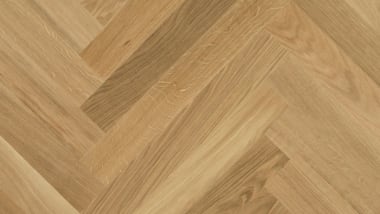
Herringbone is one of the most iconic styles of parquetry. Rectangular timber planks or blocks are laid at right angles to one another, with the ends meeting in a staggered zigzag that forms a broken “V”. The name comes from the pattern’s resemblance to the skeleton of a herring fish.
It’s a design with genuine heritage. The earliest examples appear in the jewellery of Ancient Egypt and in fabric from Ancient Italy, and Roman engineers used the arrangement to pave durable, stable roads. Over the centuries it moved indoors, into the entryways and parlours of grand estates. Read more in our short history of herringbone.
Today, designers use herringbone across residential and commercial spaces to add rhythm and texture to both classic and modern schemes.
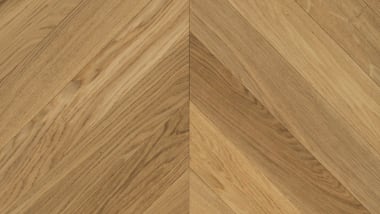
Herringbone or chevron? Herringbone uses complete rectangular blocks or planks, while chevron boards have their short ends cut at an angle so they meet in a continuous V. Our guide to chevron vs herringbone flooring covers the differences in detail.
How Havwoods herringbone is made
Our herringbone flooring is engineered timber: a genuine hardwood wear layer bonded to a stable, multi-layer construction. Most of our herringbone is pre-finished, so there’s no staining or sealing on site, and an unfinished option is available in the H Collection Classic range.
Formats range from compact 490 x 70mm blocks in The Italian Collection to 680 x 136mm boards in The Australian Collection. Browse the full selection on our herringbone flooring and panelling page.
How much does herringbone flooring cost in Australia?
There isn’t a single price for herringbone, because the final figure depends on the product and the project. Here’s how the cost is shaped, so you can plan with confidence.
Herringbone pricing by Havwoods tier
Havwoods groups its ranges into three tiers based on relative price and value. The tiers reflect the design flexibility, material innovation and craftsmanship behind each collection, not just price.
| Tier | Starting from | Herringbone ranges | What to expect |
| Essentials | $103 per m² | H Collection, H Collection Classic, V Collection | Entry-level products that uphold Havwoods’ standards. Well suited to residential builds, investment properties and multi-residential developments. |
| Iconic | $121 per m² | PurePlank 2.0, The Australian Collection, The Italian Collection, Luxe Collection | Mid-tier ranges with a wider palette of colours, specialty finishes and enhanced sustainability certifications. |
| Prestige | $182 per m² | Venture Plank | Expertly crafted engineered timber for high-end residential and boutique commercial interiors. |
Note: These starting points are indicative and apply across each tier, not to herringbone alone. For a quote on a specific product, request pricing or get in touch with our team.
What affects the cost of a herringbone floor?
| Cost factor | How it affects the price |
| Pattern | Herringbone and chevron generally cost more than standard planks, with a higher allowance for waste, more complex manufacturing and longer, more precise installation. |
| Species and sourcing | Imported timbers such as European Oak cost more due to freight and limited availability. Local species can offer cost and lead-time advantages. |
| Grade | Prime grade, with minimal knots and a uniform look, is rarer and more expensive to source. Rustic grades use more of the raw timber, which makes them more accessible. See timber flooring grades. |
| Wear layer | A thicker wear layer uses more timber, so it costs more. It allows more sanding in future, but doesn’t make the floor harder or more durable. |
| Finish | Lacquered finishes are generally more cost-effective. Oiled finishes enhance the natural look of the timber and carry a higher price because the process is more intensive. |
| Surface treatments | Bevelled edges, hand-scraping, brushing and smoking add texture and character, and add to the cost. |
| Certifications | Sustainability certifications add cost, and add environmental assurance. Certifications vary by product and are listed on each product page. |
| Installation method | Glue-down involves more labour and materials than a floating floor. |
| Order size and lead time | Larger quantities can attract better pricing, while urgent or custom orders can cost more. |
What about installation costs?
Havwoods doesn’t install flooring, so installation is quoted separately by your chosen installer. We can connect you with installers in your area who are experienced working with Havwoods products. Please note: as installers operate independently from Havwoods, all installation arrangements, including quotes, scheduling and installation services, are managed directly between the installer and yourself.
Herringbone needs careful alignment and is recommended for glue-down, so it typically involves more labour and materials than a floating plank floor. A few things can add to a quote:
- Subfloor preparation: your subfloor needs to be clean, dry and level.
- Removing existing flooring: many installers offer this, but confirm up front as it may cost extra.
- Underlay: in apartments, an acoustic underlay may be required to meet building codes or body corporate requirements, and Havwoods can include underlay in your quote.
- Adhesive: our Hav:Bond Premium Timber Flooring Adhesive can be purchased with your flooring order.
Most residential installs take between 1 and 5 days, and your installer can confirm a timeframe once they’ve assessed the site. Through our installer network, you can receive multiple quotes to compare pricing and credentials.
Ways to keep a herringbone project on budget
- Start with the Essentials tier. Ranges such as the V Collection and H Collection bring the herringbone look at an accessible starting point.
- Consider the grade. Rustic grade celebrates natural variation and is generally more accessible than Prime.
- Choose a lacquered finish. It’s the more cost-effective option and a practical choice for high-traffic zones.
- Check the Clearance Collection. This rotating selection of premium products at reduced prices features end-of-line items in limited quantities. Explore the Clearance range.
- Get a quote on your quantities. Our consultants can advise on how much material your layout needs, including an allowance for cuts.
Our quarterly product directory, the Wood Book, includes pricing on all our products. View it online or request a printed or digital edition.
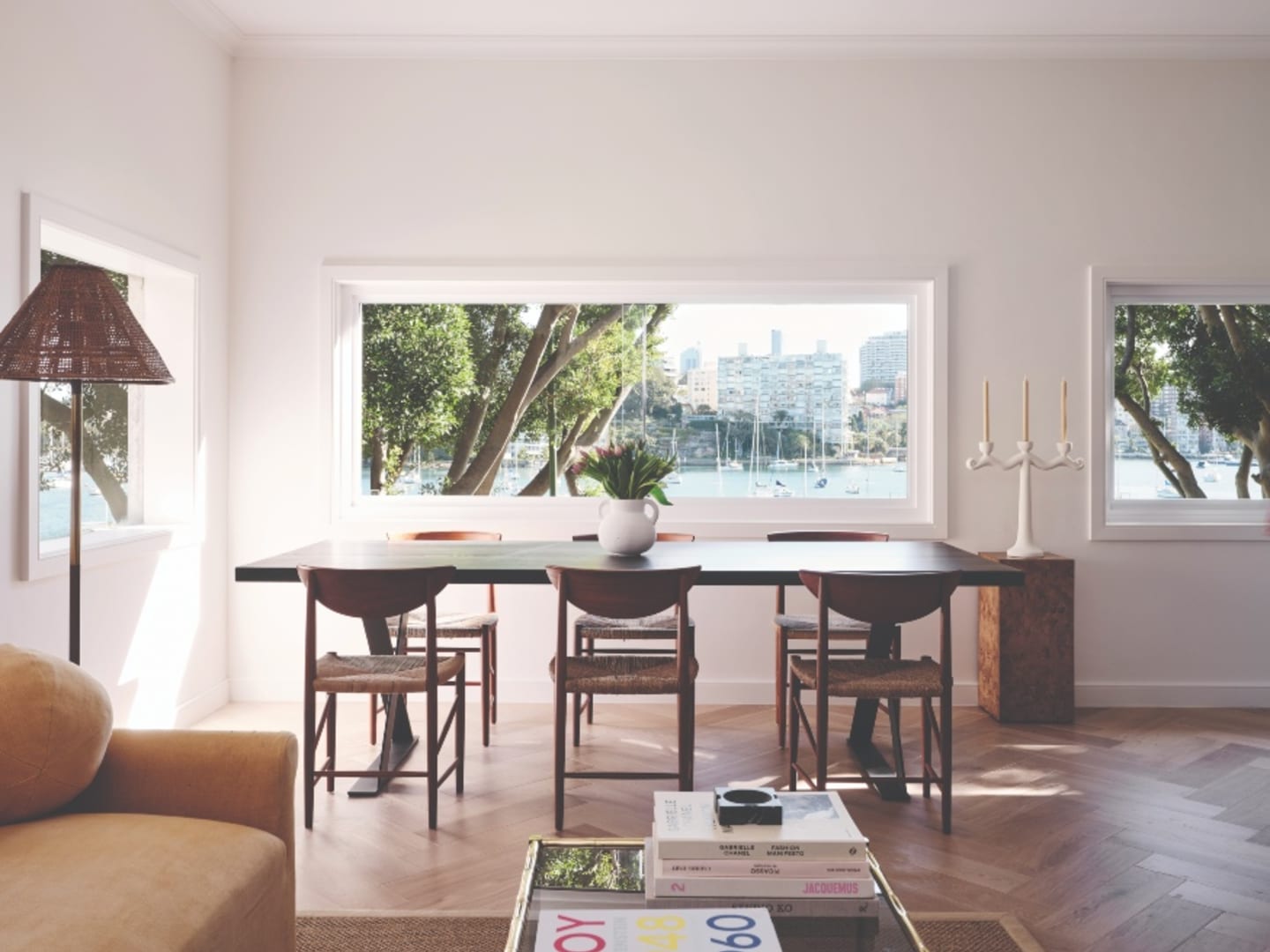
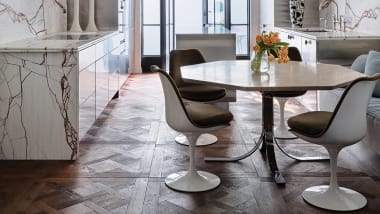
Project: Darling Point Residential | Featured timber flooring: HW3573 Ryde Herringbone, V Collection
Herringbone flooring pros and cons
| Pros | Cons |
| Timeless design with movement and texture | Higher upfront cost than straight plank flooring |
| Versatile, from heritage to contemporary | Needs a skilled installer and careful alignment |
| Works on floors and as wall cladding | Glue-down installation, so individual boards are harder to replace |
| Engineered stability, with underfloor heating compatibility on many products | Extra material for cuts and a longer installation |
| Wide choice of colours, grades, finishes and sizes | Pattern and colour need to suit the room |
| Pre-finished convenience on most products | Natural timber shows wear and variation over time |
Key benefits of herringbone for your project
- Timeless design. Herringbone has been a favourite for centuries and still feels current. Its subtle rhythm adds depth and movement without dominating a space.
- Versatility. It sits comfortably in heritage homes, modern apartments, family living rooms and boutique retail. All our herringbone flooring blocks are designed to be used as both floorboards and wall cladding panels.
- Engineered stability. Engineered timber is built in layers with the grain running in different directions, making it less susceptible to the cupping, bowing and warping that can affect solid timber, and well suited to Australia’s volatile climate. The interlocking layout of herringbone also helps keep the pattern stable.
- Real timber, more accessible. The wear layer is genuine hardwood. Herringbone, once reserved for grand estates, is now within reach of many more homes and businesses.
- Choice. Our herringbone spans European Oak and Australian Blackbutt, a full spectrum of colour groups from Platinum to Cocoa, and everything from compact blocks to wider boards.
- Ready to lay. Pre-finished products arrive with no sanding, staining or sealing on site.
A few things to consider when choosing herringbone flooring
- Cost. Herringbone generally costs more than a straight plank floor, both to buy and to install. It’s the trade-off for a floor with significantly more character.
- Skilled installation. Every piece must be carefully aligned to maintain the look and integrity of the pattern, so it’s best to employ an expert.
- Glue-down installation. Herringbone, chevron and most parquetry patterns are recommended for glue-down (direct stick), because the many small cuts and tight angles could otherwise shift and gap. It gives you a solid, stable floor, but individual boards are harder to replace than on a floating floor, so we suggest keeping a few spare boards from your order.
- Wastage and time. Patterns need extra material for cuts, and installation takes longer than a straight plank floor.
- Plank size and colour. Herringbone’s distinctive, varied pattern works beautifully in rooms of all sizes. Different plank dimensions create different visual effects, from finer, more intricate patterns to broader, more pronounced designs. Lighter tones can make a space feel more open, while darker, higher-contrast tones can create a cosier feel.Very small blocks can look busy in a large room, and dark, high-contrast tones can make a small space feel more enclosed.
- Natural variation and wear. Like all real timber, a herringbone floor will show wear over time, and UV light can gradually change its colour. These are natural characteristics of timber, not defects.
- Finish and repairs. Oiled floors are easy to spot-repair. Lacquered boards offer more surface protection, but if damaged they need to be replaced rather than repaired.
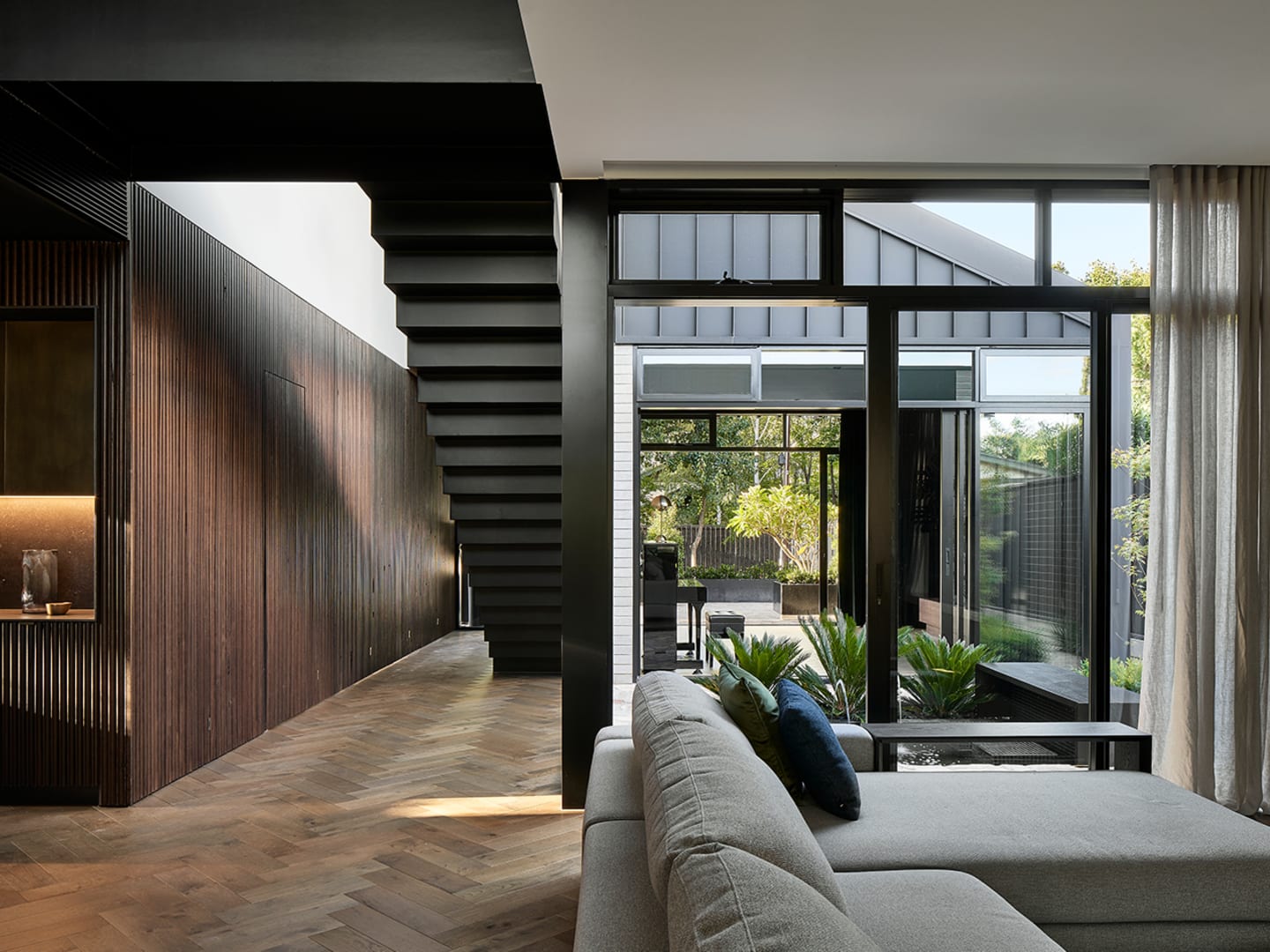
Project: Iron Chef House | Featured timber flooring: HW3577 Auburn Herringbone, V Collection
Is herringbone flooring still in style?
Herringbone isn’t so much a trend as a classic. It has been used for centuries, from grand estates to the classic residences of Ascot in Brisbane, which have featured herringbone flooring for over 100 years. It keeps finding a place in new homes, apartments and commercial fitouts because it adapts so well to both traditional and contemporary design.
Colour and scale bring it up to date. Light, natural tones feel open and airy, while deeper tones bring warmth and a more traditional look. Our herringbone flooring collection covers both ends of the spectrum.
Does herringbone flooring make a room look bigger or smaller?
It can do either. Our guide to whether herringbone flooring makes a room look bigger or smaller explores this in detail. In short:
- To feel larger: install the pattern so it leads the eye along the longest part of the room, choose lighter tones that reflect more light, use larger-format planks with fewer seams, and continue the same floor through adjoining spaces.
- To feel cosier: choose darker, high-contrast tones, use small planks.
Herringbone has a large visible variation in pattern that makes it work in rooms of all sizes. Different plank dimensions create different visual effects, from finer, more intricate patterns to broader, more pronounced appearance. The choice comes down to personal preference and the overall look you want to achieve.
Herringbone vs chevron: which flooring pattern is right for you?
Both are parquetry patterns, and both deliver impact. The difference lies in how the boards are cut and how the pattern reads across the floor.
| Herringbone | Chevron | |
| The boards | Complete rectangular blocks or planks | Short ends cut at an angle, commonly 45° |
| The pattern | A staggered, broken V | A continuous V that meets in a perfect point |
| The effect | Subtle rhythm and texture | A bold, directional zigzag |
| Installation | Careful alignment, glue-down recommended | Careful alignment, glue-down recommended |
| Cost | Generally more than straight planks | Generally more than straight planks |
Compare them in ourchevron flooring and herringbone ranges, or browse every pattern on our timber patterns page.
Engineered vs solid herringbone
Havwoods’ herringbone is engineered timber. Our guide to engineered vs solid timber flooring covers the detail, but in summary:
- Stability: layers with the grain running in different directions make engineered timber less prone to cupping, bowing and warping.
- Genuine timber: the top layer is real hardwood. “Engineered” describes the construction, not the material.
- Pre-finished: engineered boards can arrive finished, which reduces installation time and cost.
- Underfloor heating: the majority of engineered products can be fitted over underfloor heating, though conditions apply.
- Range: engineered timber comes in a much larger range of colours, sizes, patterns and finishes.
Our FAQs answer more common questions.
How to choose your herringbone floor
Grade. Grade describes the level of natural character in the timber, and our herringbone is available across all four. See our full guide to timber flooring grades.
- Prime: few, if any, knots, and minimal sapwood and filler. The cleanest, most uniform look.
- Classic: a mix of cleaner boards and boards with more knots.
- Character: similar to Rustic, but with natural knots and characteristics that are slightly smaller and less present.
- Rustic (also known as Natural): a limitless size and number of knots, plus colour variation, sapwood and filler.
Colour and species. Our herringbone spans the Havwoods colour groups: Platinum, Blonde, Honey, Auburn, Brunette, Cocoa, Smoky Grey and Monochrome. Most is European Oak, with Australian Blackbutt in The Australian Collection for projects that call for a native species. Screens vary, so always view a sample in your own light.
Finish. Oiled and UV oiled finishes penetrate the timber and bring out the colour and grain. Lacquered and matt lacquered finishes form a hard, resilient coating that protects against dirt and moisture, and are the more cost-effective choice.
Wear layer. A thicker wear layer allows more sanding in future, but doesn’t make the floor harder. Very few engineered timber floors are ever resanded, as modern finishes are durable and resanding will usually remove the original finish, texture and colouring.

Project: Georgie Residential | Featured timber flooring: HW4120 Mentone Herringbone, Venture Plank
Installing herringbone flooring
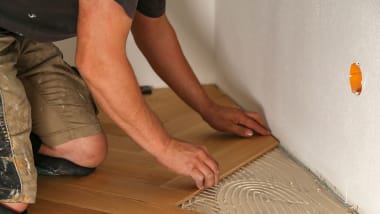
Glue-down is recommended. Herringbone and chevron involve numerous small cuts and tight angles where boards meet. Without adhesive bonding, pieces could shift and gaps could form. All Havwoods timber flooring products are suitable for glue-down, and our glue down vs floating guide explains the difference.
Preparing the subfloor. Your subfloor should be clean, dry and level, and your installer will advise on any preparation.
- Over tiles or existing floorboards: possible, but the existing floor must be sound, with no cracks, loose tiles or boards and no dampness. Floor height also needs to be considered so door clearances and transitions work. Ask your installer to obtain a technical document from Havwoods to confirm suitability.
- Apartments: glue-down with an appropriate acoustic membrane typically performs better for sound insulation than floating alternatives. Check your owners corporation’s requirements before you install.
Underfloor heating. Many Havwoods herringbone products are suitable for underfloor heating, but suitability varies between products and heating systems. Check the features on the product page and confirm with your Havwoods consultant. Glue-down is typically required, and the maximum recommended surface temperature for engineered timber is usually around 27°C. Our guide to selecting the right flooring for underfloor heating has more.
Finding an installer. We don’t install timber flooring ourselves, but we can connect you with installers in your area who are experienced working with Havwoods products. As installers operate independently from Havwoods, all installation arrangements, including quotes, scheduling and installation services, are managed directly between the installer and yourself. Our Head of Technical and Installation, Tony, has over 25 years of experience and provides guidance before, during and after installation. Learn more about our installation support or visit the document library for installation guides by range.
Caring for a herringbone floor
Herringbone is no harder to look after than any other timber floor.
- Everyday: a broom, a vacuum with a wood floor setting or a dry mop removes dust and loose debris.
- Deeper clean: for oiled floors, damp mop with a diluted oiled wood floor cleaner. Your Havwoods consultant can advise on care for your specific finish.
- Protect the surface: felt pads under furniture, rugs and entrance mats help, and trimmed pet claws reduce abrasion.
- Slow colour change: blinds or curtains can slow the effect of UV light on timber.
- Repairs: treat minor dents and scratches with maintenance products or repair kits from our accessories range. Spare boards let you replace any that can’t be spot-repaired.
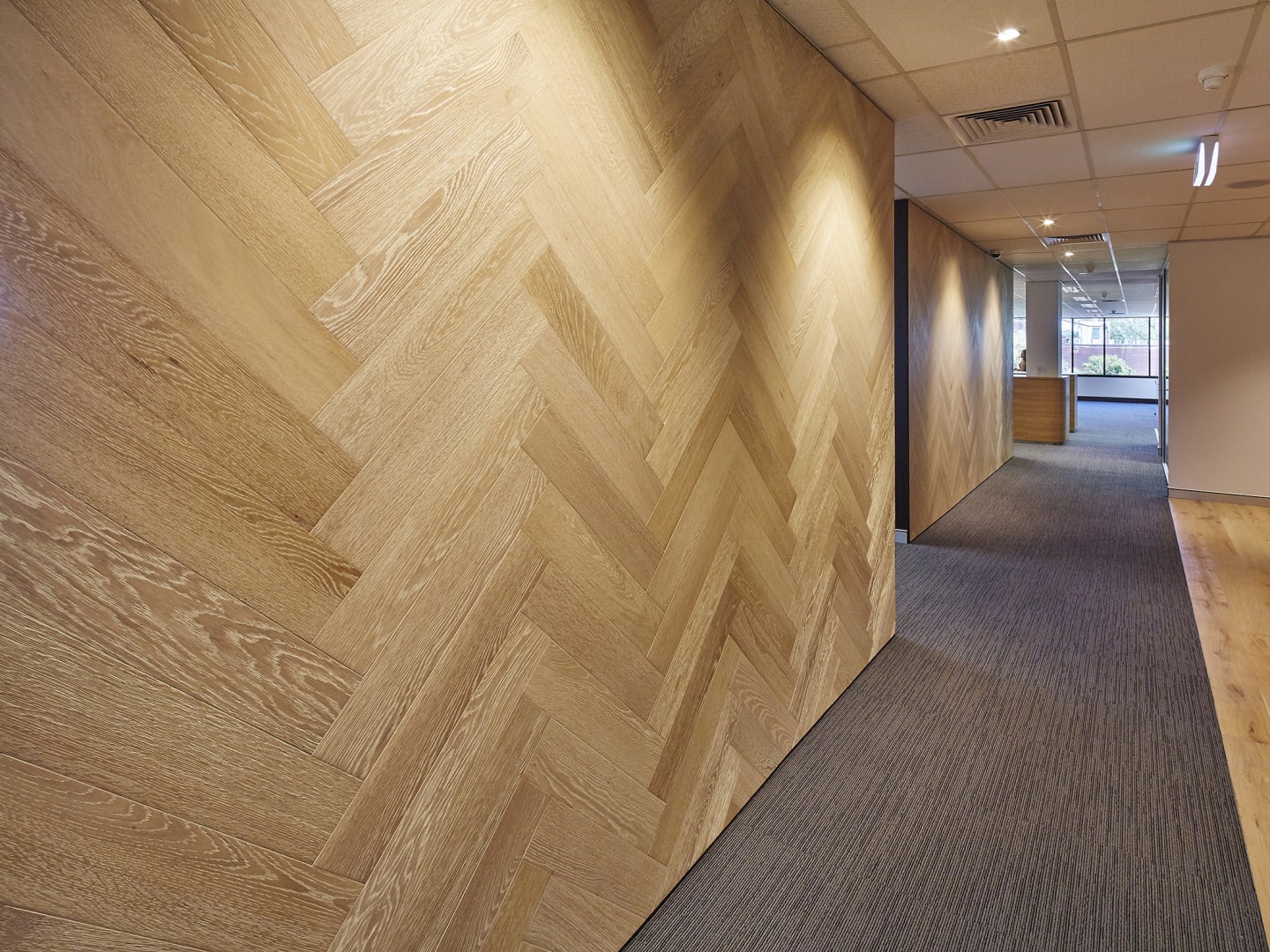
Project: Anytime Fitness HQ, Sydney | Featured timber flooring: HW694 Crystal Herringbone, V Collection
Herringbone beyond the floor
Australian designers have embraced herringbone on walls and even ceilings. Our herringbone flooring blocks are designed for use as floorboards or wall cladding, so look for the “Suitable for cladding” feature on the product page and explore more ideas for walls and ceilings.
Herringbone in Australian projects
- Anytime Fitness HQ, Sydney NSW: oversized Crystal Herringbone (HW694) used as vertical timber cladding, bringing the pattern up the wall and into the design of the whole space.
- Dobson Street Residence, Ascot QLD: The Shaw Group chose HW16006 Bronzo Block from The Italian Collection for the living areas of a transformed ground floor apartment, inspired by the neighbourhood’s classic residences.
- Croydon Herringbone for Mosman Home, NSW: Look Design Group selected HW3572 Croydon Herringbone for a high-traffic family home for its richness in texture, colour and durability.
- Mastani Retail Store, Armadale VIC: Studio Design Office used HW16002 Pallido Herringbone across a 100 m² boutique, as a base for layering tonal and textural details.
Browse more in our case studies.
A closer look at Havwoods herringbone
A selection across the three tiers, with specifications:
| Product | Range | Tier | Size (mm) | Grade | Notes |
| Botany Herringbone (HW3576) | V Collection | Essentials | 560 x 140 x 14.5 | Rustic | European Oak, Platinum, matt lacquered, suitable for underfloor heating and cladding |
| Allevard Herringbone (HW1233) | PurePlank 2.0 | Iconic | 600 x 120 x 14 | Classic | European Oak, Blonde, matt lacquered, 3mm wear layer, suitable for underfloor heating and cladding |
| Astoria Herringbone (HW6250) | Luxe Collection | Iconic | 560 x 140 x 14.5 | Classic | European Oak, Cocoa, UV oiled, 3mm wear layer, suitable for underfloor heating, 25-year residential warranty |
| Columba Herringbone (HW16009CP) | The Italian Collection | Iconic | 490 x 70 x 11 | Character | European Oak, Blonde, UV oiled, 4mm wear layer, suitable for underfloor heating, up to 20-year residential warranty |
| Australian Blackbutt Herringbone 136 (EP146) | The Australian Collection | Iconic | 680 x 136 x 14 | Classic | Australian Blackbutt, Honey, matt lacquered, 3mm wear layer, suitable for cladding |
| Blanco 13 Herringbone (HW3005) | Venture Plank | Prestige | 600 x 120 x 13 | Prime | European Oak, Platinum, extra white UV oiled, 4mm wear layer, suitable for cladding |
Note: Warranties vary by product and by residential or commercial use, and are subject to terms and conditions. Certifications are listed on each product page. Browse our sustainably certified products for more.
Is herringbone flooring worth the investment?
For many projects, yes. Herringbone brings a timeless, high-impact design in real timber, backed by engineered stability and a range of price points. If resale is part of your thinking, our guide on whether timber floors increase the value of your home explains that timber tends to lift buyer appeal and presentation rather than deliver a fixed return, and that the product should suit your local market.
See herringbone for yourself
Herringbone is best judged in person. Here’s how to explore it before you decide:
- Order free samples: choose up to 5 samples online from our herringbone range.
- Book a showroom consultation: visit our Sydney, Melbourne, Brisbane or Newcastle showroom, or the Rutherford Studio.
- Arrange a virtual consultation: if you can’t get to a showroom, our consultants can take you through the range online.
- Request the Wood Book: our quarterly product directory, with pricing.
- Request a quote: tell us about your project and we’ll price the products you’ve shortlisted.
We deliver Australia-wide, Monday to Friday between 8:00am and 5:00pm. See our delivery information. Not sure where to start? Get in touch with our team.
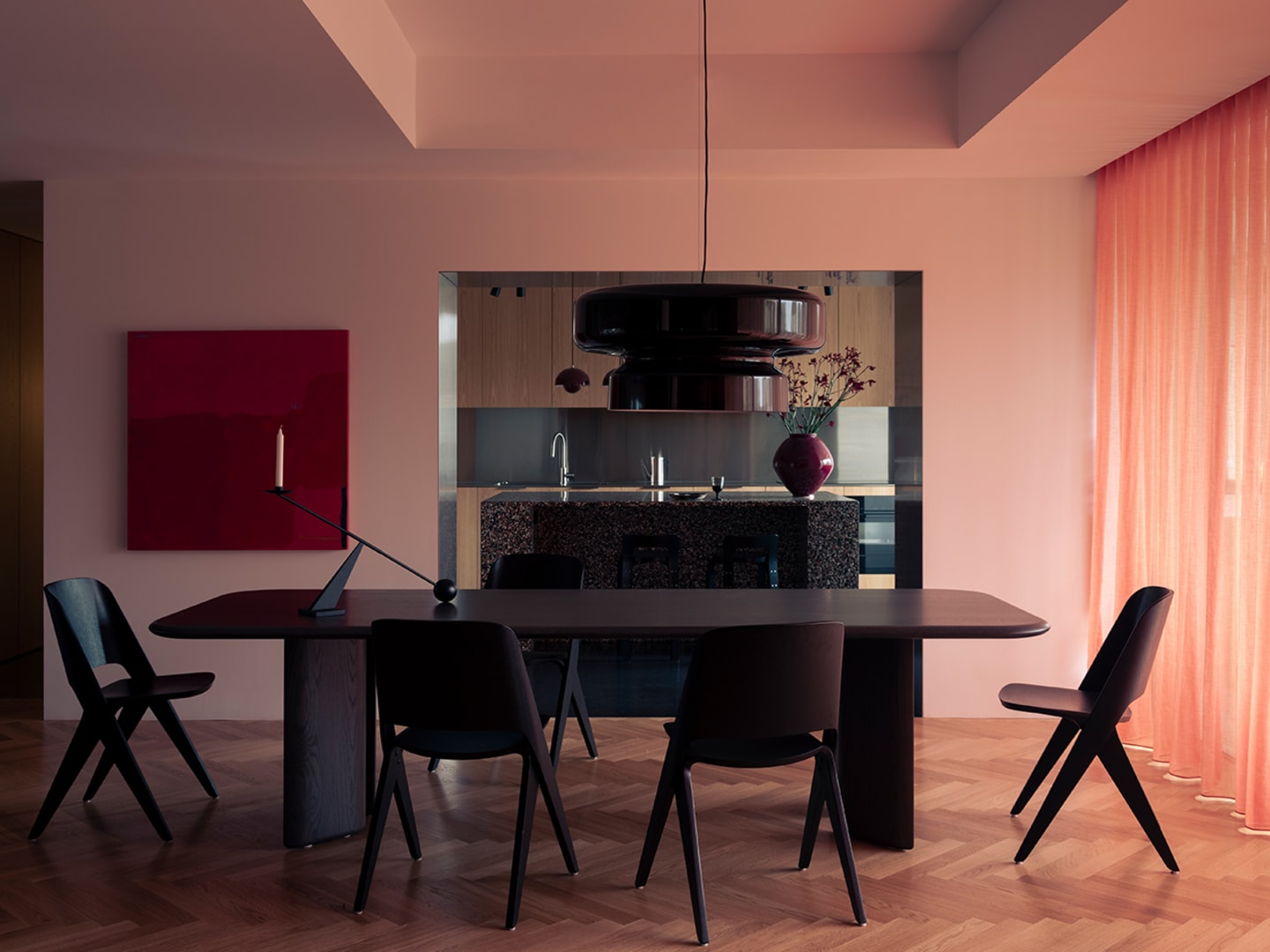
Project: Doria Apartment | Featured timber flooring: HW16002CP Pallido Herringbone, The Italian Collection
Frequently asked questions about herringbone flooring
How much does herringbone flooring cost in Australia?
Herringbone flooring generally costs more than a straight plank floor in the same timber, because the pattern needs more material and takes longer to install. Havwoods doesn’t list exact prices online, but our herringbone ranges sit across three tiers with indicative starting points of $103 per m² (Essentials), $121 per m² (Iconic) and $182 per m² (Prestige). Your final cost depends on species, grade, finish, project size and installation, so request pricing for the products you’ve shortlisted.
Is herringbone flooring more expensive than straight plank flooring?
Generally, yes. Patterned styles like herringbone and chevron typically cost more than standard planks because of higher material waste allowances, more complex board manufacturing and longer, more precise installation.
Why does herringbone cost more to install?
Every piece has to be aligned carefully to keep the pattern true, which takes more time and skill than laying straight planks. Herringbone is also recommended for glue-down installation, which typically involves more labour and materials than a floating floor.
Does Havwoods list herringbone flooring prices online?
No. Pricing changes with project scope and volume, lead times, installation and location factors, current stock levels and promotions. You can request pricing from any product page, or request the Wood Book, our quarterly product directory with pricing.
What are the pros and cons of herringbone flooring?
The pros are its timeless design, versatility across floors and walls, engineered stability and wide choice of colours, grades and sizes. The cons are a higher upfront and installation cost, the need for a skilled installer, glue-down installation and extra material for cuts.
Is herringbone flooring worth it?
For many projects, yes. Herringbone offers a timeless, high-impact design in real timber, with options across a range of price points. Timber flooring tends to lift buyer appeal and presentation rather than deliver a fixed return, so choose a product that suits your property and local market.
Is herringbone flooring still in style?
Yes. Herringbone has been used for centuries and continues to be embraced by designers in residential and commercial spaces, so it’s regarded as a timeless pattern rather than a passing trend.
Does herringbone flooring make a room look bigger?
It can make a room look bigger or smaller depending on the overall design. Lighter tones and a pattern orientation that leads the eye along the longest part of the room can make a space feel larger, while darker tones can make a space feel cosier. Read our guide to whether herringbone flooring makes a room look bigger or smaller.
What is the difference between herringbone and chevron?
Herringbone uses complete rectangular blocks or planks laid at right angles to form a staggered, broken V. Chevron boards have their short ends cut at an angle, commonly 45°, so they meet in a continuous V that comes to a point. See our guide to chevron vs herringbone flooring.
Do herringbone floors have to be glued down?
Glue-down is recommended. Herringbone, chevron and most parquetry patterns involve many small cuts and tight angles, so adhesive bonding keeps the pieces in position and maintains the pattern. All Havwoods timber flooring products are suitable for glue-down installation.
Can herringbone flooring be installed over underfloor heating?
Many Havwoods herringbone products are suitable for underfloor heating, but suitability varies between products and heating systems, so check the product page and confirm with your Havwoods consultant. Glue-down installation is typically required, and the maximum recommended surface temperature for engineered timber is usually around 27°C.
Can herringbone be laid over tiles or existing floorboards?
Often, provided the existing floor is sound. Tiles should be level, properly adhered and free of cracks or loose pieces, and floorboards should have no loose boards and no dampness. Floor height, door clearances and transitions also need to be considered, and your installer can obtain a technical document from Havwoods to confirm the floor is suitable.
Is engineered herringbone real timber?
Yes. The top layer of an engineered board, known as the wear layer, is genuine hardwood. “Engineered” describes the way the board is constructed, with layers running in different directions for added stability, not the material.
Can herringbone floors be sanded and refinished?
It depends on the product. Products with a thicker wear layer may be sanded and refinished, but very few engineered timber floors are ever resanded. Resanding will usually remove the original finish, texture and colouring, so the floor would need to be refinished on site.
How do you care for a herringbone floor?
Sweep, vacuum with a wood floor setting or dry mop for everyday cleaning, and damp mop with a diluted wood floor cleaner for deeper cleaning. Use felt pads under furniture and mats at entrances, keep pet claws trimmed, and use maintenance products or repair kits for minor scratches.
Does Havwoods install herringbone flooring?
No. Havwoods supplies the flooring. Havwoods does not provide timber flooring installation services, but we can connect you with installers in your area who are experienced working with Havwoods products. As installers operate independently from Havwoods, all installation arrangements, including quotes, scheduling and installation services, are managed directly between the installer and yourself.
Can herringbone be used on walls and ceilings?
Yes. Havwoods designs its herringbone flooring blocks to be used as both floorboards and wall cladding panels, and many products are suitable for walls and ceilings. Check the features on each product page to confirm suitability.
Can I see herringbone flooring before I buy?
Yes. You can order up to 5 free samples online, book a showroom consultation or arrange a virtual consultation.

