























Herringbone Timber Flooring & Panelling
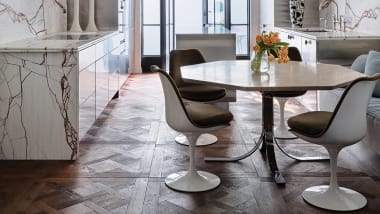
Herringbone is the most popular pattern of parquetry: rectangular timber blocks laid at right angles to one another so the ends meet in a staggered zigzag. The pattern adds movement and texture without dominating a room, which is why it suits everything from Federation cottages and inner-city terraces to new apartments and commercial fit-outs.
Every herringbone floor on this page is engineered timber with a real hardwood top layer, pre-finished in the factory and ready to glue down. Choose from European Oak, American Walnut, Australian Blackbutt and Australian Spotted Gum, in Prime, Classic, Character and Rustic grades, and in block sizes from a compact 490 x 70mm to a generous 680 x 136mm. The same blocks can be laid on walls and ceilings as well as floors.
Use the colour swatches and filters to narrow the range, then order up to 5 free samples or see full-size herringbone laid in our showrooms in Sydney, Melbourne, Brisbane and Newcastle. Still deciding between herringbone and chevron? Read Chevron Flooring vs Herringbone Flooring: What's the Difference? or browse all parquetry flooring and timber flooring by pattern.
Filter by colour:


What is herringbone flooring?
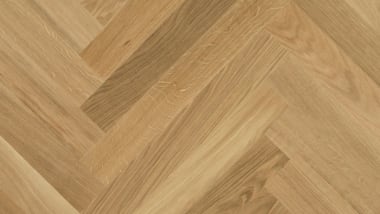
Herringbone flooring is a type of parquetry made from identical rectangular timber blocks laid at 90 degrees to each other, so that the end of one block meets the side of the next. Seen across a room, the blocks form a series of broken zigzags that resemble the bones of a fish, which is where the name comes from.
The arrangement is as practical as it is decorative. Because each block is locked against its neighbours, a herringbone floor spreads load and movement evenly across the surface. Roman engineers used the same geometry in their roads more than 2,000 years ago, and the pattern was laid in the halls and parlours of grand European houses from the 16th century onward. You can read more in our history of the herringbone pattern.
Today almost all herringbone supplied in Australia is engineered timber: a hardwood wear layer bonded to a multi-layer core, pre-finished in the factory and glued directly to the subfloor. It gives you the look of a traditional parquetry floor with far greater stability in Australia's variable climate. Herringbone is one of three parquetry patterns we stock, alongside chevron and Versailles. See all parquetry flooring or browse timber flooring by pattern.
Herringbone vs chevron: what's the difference?
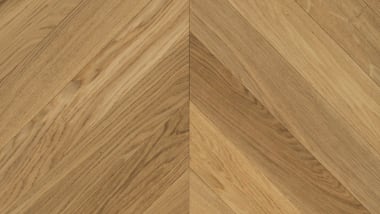
Herringbone and chevron are often confused, but they are cut and laid differently. Herringbone uses rectangular blocks with square ends, laid at right angles so the pattern steps across the floor in a zigzag. Chevron boards have their ends cut at an angle, usually 45 degrees, so each pair meets in a clean point and the rows form continuous V shapes.
Herringbone is the more traditional and understated of the two, and because the blocks need less precision milling it is usually the more accessible in price for the same species and grade. Chevron is a bolder, more directional statement that draws the eye along a hallway or an open-plan space. Many of our herringbone colours are also available in chevron and in plank, so you can carry one timber through a whole project. Read the full comparison in Chevron Flooring vs Herringbone Flooring: What's the Difference? or browse chevron timber flooring.
Choosing a herringbone floor: species, colour, grade, size and finish
Every product on this page lists its full specification, and the filters above let you narrow the range by each of the options below. Here is what they mean.
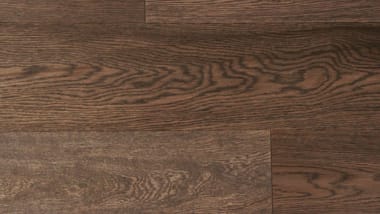
Species. European Oak makes up most of the range. It is stable, takes stains and finishes evenly, and offers the widest spread of colours. American Walnut brings a naturally deep chocolate tone without staining. For a native species and a distinctly Australian grain, Australian Blackbutt Herringbone 136 (EP146) and Australian Spotted Gum Herringbone 136 (EP148) come from our Australian Collection. Read more about Australian Blackbutt and Spotted Gum.
Colour. Herringbone is available across all eight of our colour groups: Platinum, Blonde, Honey, Auburn, Brunette, Cocoa, Smoky Grey and Monochrome. The tone comes from the timber and from the surface process, which can be brushed, smoked, fumed, stained or thermo-treated. At the pale end, Blanco 13 Herringbone (HW3005) is sanded and extra-white UV oiled; at the dark end, Bellmore Herringbone (HW6246) sits in the Monochrome group. If you are not sure where to start, read how to choose the right flooring colour.
Grade. Grade describes how much natural character shows in the timber, not its quality. Prime has few if any knots and the most uniform look. Classic mixes cleaner boards with some knots. Character shows heartwood and sapwood together with wider colour variation. Rustic has a virtually unlimited number of knots and the most variation. Herringbone in Prime or Classic grade gives a refined, consistent pattern; Character and Rustic grades celebrate the timber and suit heritage and country interiors. See our full guide to timber flooring grades.
Block size and thickness. Block size changes the feel of the floor more than any other choice. Smaller blocks read as traditional and intricate; larger formats feel calmer and more contemporary. The range runs from 490 x 70mm to 680 x 136mm, with thicknesses from 11mm to 21mm and hardwood wear layers from 3mm to 6mm.
Block format (length x width x thickness) | Collections | Examples |
| 490 x 70 x 11mm | The Italian Collection | Columba Herringbone (HW16009CP), Bronzo Herringbone (HW16006P), Pallido Herringbone (HW16002P) |
| 560 x 140 x 14.5mm | The Luxe Collection, The V Collection | Bellmore Herringbone (HW6246), Mosman Herringbone (HW3571), Croydon Herringbone (HW3572) |
| 600 x 120 x 13mm | Venture Plank | Amazon Prime 120mm Herringbone (HW3008), Blanco 13 Herringbone (HW3005), Ranger 13mm Herringbone (HW4110) |
| 600 x 120 x 14mm | PurePlank 2.0, H Collection | Allevard Herringbone (HW1233), Lyon Herringbone (HW1235), Barrington Herringbone (HW12404) |
| 600 x 120 x 20 to 21mm | Venture Plank (6mm wear layer) | Salvo Herringbone (HW3244B), Cedro Herringbone (HW3280B) |
| 680 x 136 x 14mm | The Australian Collection | Australian Blackbutt Herringbone 136 (EP146), Australian Spotted Gum Herringbone 136 (EP148) |
As a rule of thumb, match the block to the room: the 490 x 70mm blocks keep the pattern in proportion in rooms under about 15 square metres, the 600 x 120mm formats suit most living areas, and the 680 x 136mm blocks come into their own in large, open-plan spaces. Herringbone is also one of the patterns that can make a room look bigger.
Finish. Matt lacquered and lacquered floors carry a hard, resilient coating that resists scratches and dirt and suits busy households and commercial spaces. UV oiled, white UV oiled and extra-white UV oiled floors have a natural, matt look and can often be spot-repaired without recoating the whole room. Classic Unfinished Herringbone (HW6552) is supplied unfinished so it can be stained and coated on site to your own specification. Our care and maintenance guide for lacquered and oiled floors explains the difference day to day.
Collection. Herringbone appears in seven of our collections, each with its own construction, format and warranty:
- The Italian Collection: compact 490 x 70mm blocks in European Oak with a 4mm wear layer, PEFC certified, up to a 20-year residential warranty.
- The Luxe Collection and The V Collection: 560 x 140mm blocks with a 25-year residential warranty. The V Collection also includes Walnut Herringbone (HW6540D) and Burnish Herringbone (HW696).
- H Collection and H Collection Classic: 600 x 120mm Rustic-grade blocks named for Hunter Valley towns, plus the unfinished Classic option.
- PurePlank 2.0: 600 x 120mm Classic-grade blocks such as Allevard, Gosford and Orleans de Loire.
- Venture Plank: Prime and Character grades in 13mm, 20mm and 21mm thicknesses, including the FSC-certified Salvo Herringbone (HW3244B).
- The Australian Collection: Blackbutt and Spotted Gum in a 680 x 136mm format.
Selected herringbone products carry FSC, PEFC or FloorScore certification. Use the Sustainably Certified filter or browse our sustainably certified range.
Herringbone for walls and ceilings
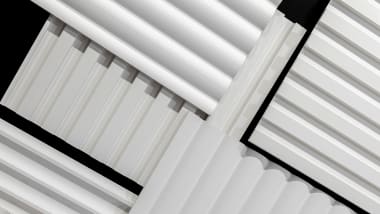
Every herringbone block in the range is designed to be used on walls and ceilings as well as floors, so the same product can run from an entrance hall up a feature wall or across a bulkhead. At Anytime Fitness HQ in Sydney, Crystal Herringbone (HW694) was laid vertically as wall cladding. Browse all wood for walls and ceilings, or read eight reasons to choose timber wall panels.
Is herringbone flooring still in style?
Herringbone has outlasted every flooring trend of the past five centuries, from the chateaux of the French Renaissance to the merchant houses of Amsterdam and the parlours of 19th-century Melbourne. It has never really gone away, and in Australia it has moved well beyond period homes.
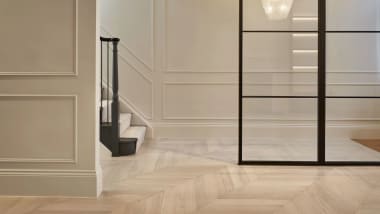
Three directions stand out at the moment. Pale and honey European Oak herringbone has become a staple of Sydney and Melbourne renovations, as in the Mosman family home laid in Croydon Herringbone (HW3572). Large-format blocks give new builds a calmer, more contemporary floor, as at the Dobson Street Residence in Ascot, Brisbane, which uses Bronzo Herringbone (HW16006P) in a block layout. And retail and hospitality designers are using it to lift commercial spaces, as at the Mastani boutique in Armadale, Melbourne, floored in Pallido Herringbone. For a longer view, read are herringbone floors on trend at the moment?
How herringbone flooring is installed
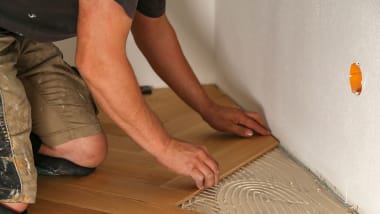
Glue-down installation. All of our herringbone is tongue-and-groove and is designed to be glued directly to the subfloor (direct stick) by a professional installer. Herringbone cannot be floated the way a click-system plank floor can, because the pattern relies on every block being fixed in position. Read more about floating versus glue-down installation.
Subfloor. The subfloor needs to be clean, dry and level. Concrete slabs should be moisture tested, and existing floorboards or particleboard may need a plywood or levelling underlay before the herringbone goes down. If you are laying over tiles, read our guide to the mistakes to avoid when installing timber over tiles.
Setting out. Herringbone is set out from the centre line of the room so the pattern runs true to the main sightline, usually down the length of the space or towards the main window. Your installer will dry-lay the first rows to check the alignment before gluing.
Wastage. Because every block at the edge of the room is cut, allow extra material for herringbone. A 15% wastage allowance is advised for areas less than 100m², reducing to 12% for larger areas.
Underfloor heating. Most of our engineered herringbone is suitable for underfloor heating, and the product page shows a "Suitable for underfloor heating" badge where it applies. Read can you install underfloor heating under timber flooring?
Who installs it. Havwoods does not provide installation services, but we can connect you with installers in your area who are experienced with Havwoods products, and we publish installation guides by range in our document library. Start with our timber flooring installation support page.
How much does herringbone flooring cost in Australia?
Herringbone generally costs more per square metre than straight-plank flooring in the same species and grade. There are more pieces per square metre, more cuts, and the floor takes longer to lay. Within parquetry, though, herringbone is usually the most accessible pattern: chevron sits a little higher because of its angled milling, and pre-assembled Versailles panels are the premium option.
The main things that move the price of a herringbone floor are:
- Species and grade. European Oak in Character or Rustic grade is typically the most accessible; Prime grade, American Walnut and the Australian species sit higher.
- Block size and thickness. Larger formats and thicker wear layers cost more per square metre.
- Surface process and finish. Smoked, fumed or thermo-treated surfaces add to the cost.
- Installation and subfloor preparation. Glue-down herringbone needs an experienced installer, and on renovation projects the subfloor is often the biggest variable.
- Wastage. 15% for areas less than 100m², 12% for larger areas.
Every Havwoods product is priced in the Wood Book, our quarterly product directory. Request a quote on the products you have shortlisted and we will price your project with the quantities and accessories you will actually need. For a broader view of what drives flooring prices, read our timber flooring cost guide.
Why choose a herringbone floor from Havwoods?
Fifty years of timber expertise. Havwoods has been family-owned since 1975, and every one of our 300-plus products is selected, tested and supported so that it performs in real spaces. Read our story.
European Oak and Australian species. Our oak herringbone is sourced from reputable European mills, and our Australian Collection brings Blackbutt and Spotted Gum to the pattern.
Responsibly sourced. Selected herringbone products carry FSC, PEFC or FloorScore certification, and we source from mills that manage their forests for the long term. Read about our approach to sustainable timber.
Pre-finished and warranted. Every herringbone block arrives sanded and finished, with no on-site staining or sealing, and is backed by a residential warranty of up to 25 years depending on the collection. The warranty is listed on each product page.
See it before you buy. Order up to 5 free samples online and we will post them the next business day. To see full-size herringbone laid, visit our showrooms in Sydney, Melbourne, Brisbane and Newcastle, or our Rutherford Studio in the Hunter, or book a virtual consultation.
Delivery Australia-wide. We deliver to any safe and accessible site in Australia, Monday to Friday between 8:00am and 5:00pm. See our delivery information.
Support through installation and beyond. Our team can connect you with experienced installers in your area, our installation guides are available by range, and our technical team is on hand before, during and after your project.
Herringbone projects across Australia
- Croydon Herringbone for a Mosman home, NSW: Rustic-grade European Oak herringbone (HW3572) for a high-traffic family home by Look Design Group and Reliant Constructions.
- Dobson Street Residence, Ascot QLD: Bronzo Herringbone (HW16006P) in a block layout for a Brisbane luxury home.
- Mastani Retail Store, Armadale VIC: Pallido Herringbone from The Italian Collection across a 100 square metre boutique.
- Anytime Fitness HQ, Sydney NSW: Crystal Herringbone (HW694) used as vertical wall cladding.
See more in our case studies or filter the inspiration gallery by pattern.
Frequently asked questions about herringbone flooring
What is herringbone flooring?
Herringbone flooring is timber flooring made from rectangular blocks of equal size laid at right angles to each other, so the end of one block meets the side of the next and the pattern forms a staggered zigzag across the room. It is one type of parquetry, alongside chevron and Versailles. Most herringbone supplied in Australia today is pre-finished engineered timber with a real hardwood top layer, glued directly to the subfloor.
What is the difference between herringbone and chevron flooring?
Herringbone blocks have square ends and are laid at 90 degrees so the pattern steps across the floor in a zigzag. Chevron boards have their ends cut at an angle, usually 45 degrees, so each pair meets in a point and the rows form continuous V shapes. Herringbone is the more traditional and understated of the two and is usually the more accessible in price; chevron is the bolder, more directional statement. Read chevron vs herringbone: what's the difference?
Is herringbone timber flooring expensive?
Herringbone costs more per square metre than straight-plank flooring in the same species and grade, and it takes longer to lay, but it is usually the most accessible of the parquetry patterns. The price depends on species, grade, block size, wear layer, surface finish and the condition of the subfloor. Every Havwoods product is priced in the Wood Book, and you can request a quote on the products you have shortlisted.
Does herringbone flooring make a room look bigger?
Generally, yes. The diagonal lines of a herringbone floor draw the eye outward and across the space rather than along straight planks, which makes most rooms feel wider. In a small room, choose a smaller block such as 490 x 70mm so the pattern stays in proportion; in a large, open-plan space, a 600 x 120mm or 680 x 136mm block gives a calmer effect. Read does herringbone flooring make a room look bigger?
What sizes do herringbone blocks come in?
Havwoods herringbone blocks range from 490 x 70mm (The Italian Collection) through 560 x 140mm (The Luxe and V Collections) and 600 x 120mm (PurePlank 2.0, H Collection and Venture Plank) to 680 x 136mm (The Australian Collection). Thicknesses run from 11mm to 21mm, with hardwood wear layers from 3mm to 6mm. The full specification is listed on every product page.
Which timber species are available in herringbone?
Most of the range is European Oak, which is stable, takes finishes evenly and comes in the widest choice of colours. Herringbone is also available in American Walnut, and in Australian Blackbutt and Australian Spotted Gum from the Australian Collection for projects that call for a native species.
Is engineered herringbone flooring real timber?
Yes. The surface you walk on is genuine hardwood, from 3mm to 6mm thick, bonded to a multi-layer core that keeps the floor stable in Australia's variable climate. "Engineered" describes the construction, not the material. Floors with a thicker wear layer can be sanded and refinished later in life.
Is herringbone hybrid or laminate flooring the same as timber herringbone?
No. Hybrid and laminate herringbone products are a printed image of timber on a composite or fibreboard core. Havwoods herringbone is engineered timber with a real hardwood wear layer, so every block has its own grain and colour variation, it can be sanded and refinished, and it can be used on walls and ceilings as well as floors.
Can herringbone flooring be laid as a floating floor?
No. Havwoods herringbone is tongue-and-groove and is designed to be glued directly to the subfloor (direct stick) by a professional installer, so that every block stays aligned and the pattern holds true. It cannot be floated the way a click-system plank floor can. See our installation support page.
Can you lay herringbone flooring over existing floorboards or tiles?
Often, yes, provided the existing surface is sound, dry and level. Some subfloors need a plywood or levelling underlay first, and tiles need to be checked for hollow spots and moisture before the floor goes down. Your installer will assess this on site. Read our guide to the mistakes to avoid when installing timber over tiles.
Can herringbone flooring be installed over underfloor heating?
Most Havwoods engineered herringbone is suitable for underfloor heating. Look for the "Suitable for underfloor heating" badge on the product page, and check the heating system's surface temperature limits with your installer before specifying. Read can you install underfloor heating under timber flooring?
How much extra flooring do I need for herringbone?
Allow extra material for the blocks that are cut at the edges of the room, typically 10 to 15 per cent for herringbone, and more for rooms with alcoves, bay windows or angled walls. Your installer can confirm the allowance once the layout is set out.
How do you clean and maintain a herringbone floor?
Sweep or vacuum with a soft-brush head to remove grit, then use a well-wrung damp mop with a cleaner suited to the finish. Avoid soaking the floor and do not use steam mops. Felt pads under furniture and mats at external doors prevent most scratches. Oiled floors can be spot-repaired and re-oiled in high-traffic areas; lacquered floors can be re-coated when the finish eventually wears. See our care and maintenance guide.
Can herringbone blocks be used on walls and ceilings?
Yes. Every herringbone block in the Havwoods range is designed for walls and ceilings as well as floors, so one product can run from a floor up a feature wall or across a ceiling. Crystal Herringbone was laid vertically as wall cladding at Anytime Fitness HQ in Sydney. Browse wood for walls and ceilings.
Does Havwoods install herringbone flooring?
No. Havwoods supplies the flooring and can connect you with installers in your area who are experienced with Havwoods products. Installation arrangements, including quotes and scheduling, are made directly with the independent installer. Installation guides for each range are available in our document library.
Where can I see herringbone flooring in person?
Order up to 5 free samples online and we will post them the next business day. Samples show the colour, finish and texture of the timber; to see the laid pattern at full size, visit a Havwoods showroom in Sydney, Melbourne, Brisbane or Newcastle, or the Rutherford Studio, or book a virtual consultation.
